Printed fromJewishBellaire.com
ב"ה

Rabbi's Blog

Thoughts and Musings by Rabbi Yossi Zaklikofsky

Why Do You Show Up on Yom Kippur?


Why do so many Jews who may not walk into a synagogue all year feel compelled to show up on Yom Kippur?

Some might suggest that it is because they want to have their sins atoned for. There is certainly truth to that. But that explanation does not do justice to what is really happening.

Why would someone who rarely goes to Shul suddenly feel the need “to be there” on this one particular day?

Let’s look at the relationship between a parent and a child. There may be times when a child has been away from home for a while. Life gets busy and the child doesn't necessarily think about coming home. But then a birthday arrives, or an anniversary, or some other significant time of year. And suddenly, the child feels a tug. Something inside says, “I should go home.”

It isn't because someone told him to. It is because the relationship itself is being awakened.

And perhaps something similar happens every year during the Rosh Hashana-Yom Kippur season. It is a unique time when G-d makes Himself especially available and accessible to us. The door is open. He is reaching toward us.

That is why it should not surprise us when, during these days, a Jew suddenly feels a pull toward something Jewish. It may be the thought, “I should go to synagogue this year.” It may be an unexpected conversation, a moment of inspiration or an encounter that seems to happen by chance. But perhaps there is something deeper taking place: G-d is taking the first step.

He is reminding us that no matter how far we may have wandered the relationship is intact. And when we feel that tug and respond by showing up, we are responding to His invitation to come home.

Yom Kippur is the one day of the year when we can uncover that deeper relationship with G-d. Beneath our successes and failures, beneath everything we have done right and wrong, is an essential bond between G-d and His children that cannot be broken.

Through fasting, prayer and other Mitzvot, we align ourselves with the holiness of the day, allowing ourselves to be lifted above the negative energy of the past year and reconnect with something deeper.

Perhaps that is why so many Jews show up on Yom Kippur. They sense that G-d is looking for them.

**

We look forward to welcoming you in the days ahead. Come pray with us, reconnect and experience the warmth and meaning of being together. From our hearts to yours, we wish you and your loved ones a year filled with health, happiness, peace, purpose and abundant blessings.


How Do You Keep It Fresh?


In every area of life, we look for ways to improve. We drive a car for a few years and then start thinking about the newer model. We get the latest iPhone, and before long, we're wondering what the next one will offer. We are constantly upgrading, improving and looking for something new.

For something to stay alive, it needs a sense of freshness. It needs to remain exciting, challenging and evolving.

I remember a Rabbi who spoke at one of our conventions and shared a rule he had made for himself as a teacher. Every three years, he takes all the worksheets, tests and papers he has prepared for his students and puts them through the shredder. Why? So that he forces himself to think of new ideas and fresh approaches, making him a more effective teacher for his students rather than falling into the rut of simply repeating what he has done before.

This is the perspective with which I am trying to enter the new year.

The two names of this week's Torah portion represent two seemingly opposite ideas. ‘Nitzavim’ means standing firmly, while ‘Vayeilech’ means moving forward. In Judaism, there are components that are rock solid and timeless. The values of Torah and the Mitzvot are our anchor. They define who we are and what we stand for and they will never change.

But it is also necessary for us to advance, grow and make progress. We can come up with novel Torah insights. We can observe the same timeless Mitzvah with greater vigor, greater beauty and greater personal investment. We may pray the same words regularly, but we can bring more heart, focus and intention to those words than we did yesterday.

As we rapidly approach a new year and set goals for ourselves in every area of life, let's make sure that our personal Judaism is part of that. If we are already doing something good, let's hold onto it firmly, but let's also find something new to learn, a Mitzvah to introduce or enhance, or a way to deepen our Jewish identity, pride and observance.

We don't need to change what makes Judaism Judaism. We need to keep bringing something fresh to the way we live it. That is the balance: remaining firmly anchored in who we are, while never standing still.

Are You Just Going Through the Motions?


There is a difference between experiencing something and allowing it to become part of you.

We encounter things every day that make an impression on us. We hear something inspiring, experience a meaningful moment or receive something special from someone, and for a moment we feel moved. Sometimes that feeling remains just that, a momentary reaction. Other times, something goes deeper. We think about it, reflect on it and allow it to change us. It becomes part of who we are and eventually influences how we act.

Gratitude is a good example.

Someone does something wonderful for us, and we immediately feel grateful. We recognize the kindness and we say thank you. But there is another level of gratitude that comes when we stop and think about what they actually did for us. We consider the details, the effort, the thoughtfulness and the impact it had on our lives. The more we contemplate it, the more deeply we appreciate it. It may even inspire us to express our appreciation through action rather than simply words.

There is a fascinating discussion about the Mitzvah of ‘Bikkurim’, bringing the first fruits to the Temple as an expression of gratitude to G-d for the gift of the Land of Israel. The sages differ on when this obligation actually set in. One opinion says it began as soon as the Jewish people entered the Land. Another opinion says the obligation did not begin until fourteen years later, after the Land had been settled and each tribe was able to fully experience the gift they had received.

Perhaps both have a point. There is the initial recognition of a gift, and then there is the deeper appreciation that comes from living with it, contemplating it and truly experiencing what we have been given.

I thought about this when I received a rather unexpected phone call this week. A prominent lawyer in town called to ask me about something his son was interested in: learning Talmud. He wanted my recommendation about which edition to purchase. I was impressed. Here was a family looking to go deeper, finding a way to integrate serious Jewish learning into their life.

As we prepare for the High Holidays, we have a choice as well. We can check in with Judaism as we do every year, go through the prayers and familiar rituals, and then return to our regular lives.

Or we can resolve that this year will be different. We can allow the prayers, the Torah, the Shofar and the experience of the High Holidays to penetrate a little deeper, so that what we experience during these days continues to influence the way we live throughout the year.

Rosh Hashana is called the ‘head’ of the year. Perhaps our goal should be to allow the head of the year to influence the entire body of the year that follows.

This year don’t just go through the motions. Let it become part of you.

Do the High Holidays Give You Anxiety?


As children, we are often given simple images to help us understand big ideas. A great example is G-d. We may be taught to imagine Him as a King in heaven, watching over the world and judging our actions. As we grow older, the hope is that we continue to learn and broaden the depth of our understanding of everything, including G-d.

The High Holiday season brings that relationship back into focus. We turn to G-d asking to be remembered favorably and inscribed in the Book of Life. Yet if our only understanding of G-d is as a King sitting in judgment, approaching Him can naturally evoke a certain measure of unnecessary anxiety.

Today, I want to introduce another, remarkably empowering way to understand this relationship.

We are partners.

How are we partners with G-d?

G-d created the world, a world that is far from perfect, yet filled with extraordinary potential for goodness, kindness and holiness. Then He entrusted it to us. He asks us to cultivate it, improve it and reveal the goodness and G-dliness hidden within it.

Think about the profound trust that represents. He could have created a world in which everything was already perfect. Instead, He created a world that needs our involvement and gave us the responsibility to help complete it.

We are, in a sense, managing partners in G-d's world.

And like any managing partner, we have responsibilities, but we also have a Partner who has committed to supporting us. G-d has entrusted us with His world and, so to speak, obligated Himself to provide what we need to carry out the responsibility He has given us.

We do our part to the utmost, and then we can turn to our Partner with confidence. Our prayers can be filled with the expectation that He will provide what we need to fulfill the mission He has entrusted to us.

As we approach Rosh Hashanah, we are not simply approaching a distant Judge and hoping He will look favorably upon us. We are approaching the One who entrusted us with a role in His creation.

We can say: “G-d, You have given me a mission and entrusted me with a part of Your world. I am doing everything I can to cultivate it. Please give me the health, strength, livelihood and peace I need to fulfill it. Help me succeed in the work You have entrusted to me.”

That is the spirit in which I invite you to join us at The Shul this High Holiday season. Together, we will pray, reflect and celebrate, entering the New Year with a renewed sense of our relationship with G-d and the mission He has entrusted to each of us. Come be part of it, and let’s begin the year connected, inspired and uplifted.

Are You Sure You Want What You Deserve?


Imagine a parent making a deal with a child: If you do your homework or clean your room, I'll give you a certain reward. The child does what they were asked to do and receives the reward. In a sense, they earned it. They fulfilled their part, and the parent fulfilled theirs.

But there is something the child can easily overlook: Who gave them the ability to fulfill their side of the deal in the first place?

The parent provided the home, the education, the food, and so much of what enabled the child to accomplish what they did. Even what the child "earned" was made possible by everything they had already received from the parent.

In our relationship with G-d, there are two ways to approach it.

One approach is to recognize the system G-d created. We do our part: we live Jewishly, fulfill Mitzvot, give charity, and strive to live according to His will. We trust that G-d will respond with the blessings He promises.

But there is a deeper way to approach G-d. Instead of saying, "G-d, I did my part, now You do Yours," we recognize that even our ability to do our part is itself a gift from Him.

Our health, talents, opportunities, resources, relationships are all blessings from above. So even when a blessing comes as a result of our efforts, those very efforts were only possible because of blessings we received first.

That realization helps us see G-d's kindness woven into every part of our lives.

As we enter the month of Elul leading up to the High Holidays, we naturally have many prayers and hopes for the coming year. The best way to approach those prayers is not to say, "G-d, I did mine, now please do Yours." It is to say, "G-d, I will do everything I can. But ultimately, I know that everything I have and everything I am capable of doing comes from You. In Your infinite kindness, please bless me and my family with a beautiful and blessed year."

But perhaps the best way to achieve those blessings is to start by doing the same for others. If we hope that G-d will look beyond what we have earned and bless us with kindness and generosity, we should strive to do the same for those around us, giving more than is expected and treating others with greater generosity than they may deserve.

Do You Own It?


Anyone can lead when things are going well. The true test of leadership comes when they are not.

When disappointment, failure, or crisis strikes, true leaders do not ask, "Whose fault is this?" They step forward, accept responsibility and ask, "What needs to be done now?"

One of the most painful moments in Jewish history came with the sin of the Golden Calf. Moses had just descended from Mount Sinai with the Torah, only to find the people worshiping the calf. In an instant, everything seemed to have fallen apart.

Moses did not distance himself from the nation or abandon them in their failure. He shattered the Tablets, stood before G-d on their behalf, pleaded for their forgiveness, and accepted the enormous burden of leading a broken people through one of their darkest moments.

Interestingly, before shattering the Tablets, the Torah emphasizes that Moses "took hold of them." This was more than a physical detail. By grasping the Tablets himself, Moses accepted full responsibility for what was about to happen, ensuring that the Jewish people would not share in the blame. It was an extraordinary act of leadership and ownership.

On Monday we mark the Yartzeit of Rabbi Levi Yitzchak Schneerson, the Rebbe's father. As Chief Rabbi of Dnipro under the Soviet regime, he refused to compromise on Jewish observance despite immense personal danger. He fought tirelessly to preserve authentic Judaism, particularly maintaining Kosher standards, fully aware that the authorities would hold him personally responsible. He knew exactly what the consequences could be, yet he never wavered. The price was immense. He was arrested, exiled, and ultimately lost his life because of his unwavering commitment.

Both Moses and Rabbi Levi Yitzchak teach us the same lesson. Leadership is not measured by the applause we receive when things succeed, but by the responsibility we are willing to accept when they do not. It means having the courage to stand for what is right, even when the consequences fall squarely on our own shoulders.

Our sages teach that each of us possesses a spark of Moses. Every one of us leads in some way, our families, our friends, our workplaces, or our communities.

True leadership begins the moment we stop asking, "Whose fault is this?" and start asking, "What is my responsibility?"

Can You Still Sing the Kiddush by Heart?


This past week, someone shared something with me that caught my attention. He told me he had recently begun setting aside time to study Torah again on his own.

"Something interesting is happening," he said. "As I'm learning, things I learned years ago are suddenly coming back to me. Ideas, stories... it is all starting to come alive again."

The comment resonated with me because I have seen the same phenomenon many times. Most people I meet carry with them some memory of Judaism from their youth. For some, it is a prayer they learned in Hebrew school. For others, it is the melody of Kiddush, the blessing over the Shabbat candles, or even the opening verse of their Bar Mitzvah Haftorah that they still remember by heart.

Yet for many people, those memories have slowly faded over time. The songs, prayers and ideas that were once familiar can become distant and harder to access.

Why is it that some people remember so much of what they learned years ago, while others struggle to recall it? Often, the difference is whether they continued learning and kept that part of their lives active.

There is an old saying: "If you don't use it, you lose it." The same is true spiritually. Every time we study Torah, attend a class, pray, or engage more deeply with Judaism, we breathe new life into everything we learned before. Ideas that seemed forgotten suddenly become familiar again. Our earlier learning, so to speak, is reawakened.

This may also explain why the Shema tells us, "These words shall be upon your heart today." Our relationship with Torah should never feel like something we once learned years ago. It should feel current, alive, and as meaningful as the day we first received it.

Every week, I have the privilege of studying Torah with people from all walks of life. Some sessions last an hour, while others are just ten or fifteen minutes. I have found that consistency matters far more than duration. A small amount of Torah, learned regularly, keeps a lifetime of Jewish learning vibrant and alive.

Judaism was never meant to become a childhood memory tucked away somewhere in the back of our minds. It was meant to remain a living relationship that continues to grow throughout our lives.

Should an Antisemite be Welcomed to Israel?


This week, social media was consumed by a passionate debate surrounding Clavicular, a young influencer with millions of followers, who visited Israel. The trip exposed him to the beauty and safety of the land, the Israeli people and culture.

At the same time, a video resurfaced of him previously singing antisemitic songs, leading to a fierce discussion. Should someone with such a past be welcomed and embraced before publicly acknowledging and apologizing for his actions? Or should we believe that exposure to truth, education and friendship can inspire someone that young to grow and change?

The debate touches on a much deeper question: When we look at a person, do we only see who they are today, or do we also recognize who they have the potential to become tomorrow?

This week is the Shabbat of Vision (Chzaon). The Chassidic masters teach that on this Shabbat, every Jew is shown a vision of the Third Holy Temple that will be rebuilt very soon in the Messianic era. Yet many of us have never consciously experienced such a vision. How exactly are we shown something we do not see?

The answer is that the vision is not necessarily seen with our eyes, but with the deeper dimension of our soul, often called our ‘Mazel’.

Every person has two realities within them. There is the person we are today, the choices we have made, our strengths, and our struggles. But there is also a deeper version of ourselves: the person our soul already recognizes as our highest potential.

The purpose of this vision is to inspire us to become the person our soul already knows we can be.

Perhaps this is also how we should view others. This does not mean ignoring harmful actions or excusing mistakes; accountability matters. But Judaism teaches us that no person is defined only by their lowest moments. Within every individual exists a deeper soul, a capacity for growth, goodness and positivity.

As we prepare for Tisha B’Av, we remember that the destruction of the Temple came because of division and baseless hatred. Its rebuilding will come through the opposite: seeing the Divine potential in one another, replacing baseless hatred with baseless love and choosing to bring out the best in those around us.

The world is not transformed by giving up on people. It is transformed when we believe deeply enough in their potential that we help them become who they were meant to be.

What Will Your Family Look Like in 20 Years?


We spend enormous amounts of time thinking about our financial future. We plan our careers, contribute to retirement accounts and make decisions today based on the life we hope to have decades from now.

Why? Because we understand that the future does not happen by accident. The choices we make today determine the reality we will experience tomorrow.

But do we apply that same level of thought and planning to the future of our families? Do we think with the same intentionality about the values our children will carry, their relationships, and the role Judaism will play in the decisions they make throughout their lives?

Of course we belong to a synagogue, attend Jewish events and support Israel. But if we hope that Judaism will become a defining and stabilizing force in their lives, influencing the choices they make about marriage, raising children and building their own homes, we cannot simply hope that it will happen on its own.

The Torah teaches us about the tribes of Gad and Reuven. When they requested to settle on the other side of the Jordan River, they emphasized the abundance of their livestock and the opportunity it provided for their possessions. Moses noticed something subtle: their priorities were out of order. Their possessions came before their children. He reminded them that financial stability is important, but it is a means to support what truly matters.

This is why the small choices we make every week matter so much.

On a Friday night, it is possible to light candles, eat Challah and then move on to the next activity. But there is another option: to create a meaningful Shabbat experience. To sit together as a family, without phones or distractions, enjoying a beautiful meal and meaningful Jewish conversation.

One evening alone may not change everything. But week after week, year after year, those moments build something powerful: a stronger marriage, family bond and a deeper connection to Judaism.

The same is true with synagogue attendance, Jewish learning and Mitzvot. Perhaps it is not always the most popular or convenient choice in the moment. Just as we are willing to set aside money today rather than spend it on immediate pleasures because we are investing in our future, we must also be willing to make choices today that invest in the future of our family and our Jewish identity.

We understand the power of compound interest. Small investments made consistently over time eventually create something significant. Judaism teaches us the power of compound impact. Every Shabbat dinner, every Mitzvah and every meaningful moment is another investment in the future of our family.

The future does not happen by accident. It is built, one choice at a time and with G-d's help, bears fruit for generations.

Why Is It Always the Same People?


We all know the saying: if you need something done, ask a busy person. Shouldn’t we ask someone with extra time? The reason this often proves true is because certain people simply operate differently. They live with initiative and are naturally in motion. They are accustomed to showing up, helping and taking responsibility. You do not need to change who they are in order to get something done because they are already in that space.

The same is true in life more broadly. Heroes rarely emerge from nowhere. We sometimes imagine that extraordinary people suddenly rise to the occasion when history calls upon them. More often, people rise to the occasion because they have spent years living with purpose, generosity and conviction. When the moment arrives, they simply continue being who they already are.

Pinchas did not suddenly become extraordinary in a single moment. He lived with purpose, courage, and complete devotion to what was right, and that is why when the moment arrived, it was he who stood up while others stood silent.

The Talmud teaches that “one who sees Pinchas in a dream will encounter wonders." Perhaps on a deeper level this means that if we “dream,” aspire and strive to live as Pinchas lived, seeking every day to make a positive impact and refusing to live passively, then wonders begin to appear in our own lives as well. When a person chooses to live with purpose and conviction, G-d often blesses those efforts in ways they never anticipated. Doors open, opportunities emerge and one good deed often leads naturally to another.

When Jews arrived in America from Europe they faced a completely different reality. Many worried that the comforts and opportunities of the United States would weaken their commitment to Jewish life that had been taken for granted in the old country. Yet there were those who brought with them the same devotion and ideals they had lived by before, continuing to build Jewish life with strength and pride even under entirely new circumstances.

As we celebrate 250 years of the USA, we thank G-d for the tremendous blessing of living in a country that has allowed us to live openly and proudly as Jews. And we pray that this blessing continues for generations to come, as each of us makes the daily choice to live as an example of Jewish values, inspiring others to live lives of purpose, goodness and faith.

What I Learned in Washington, D.C.


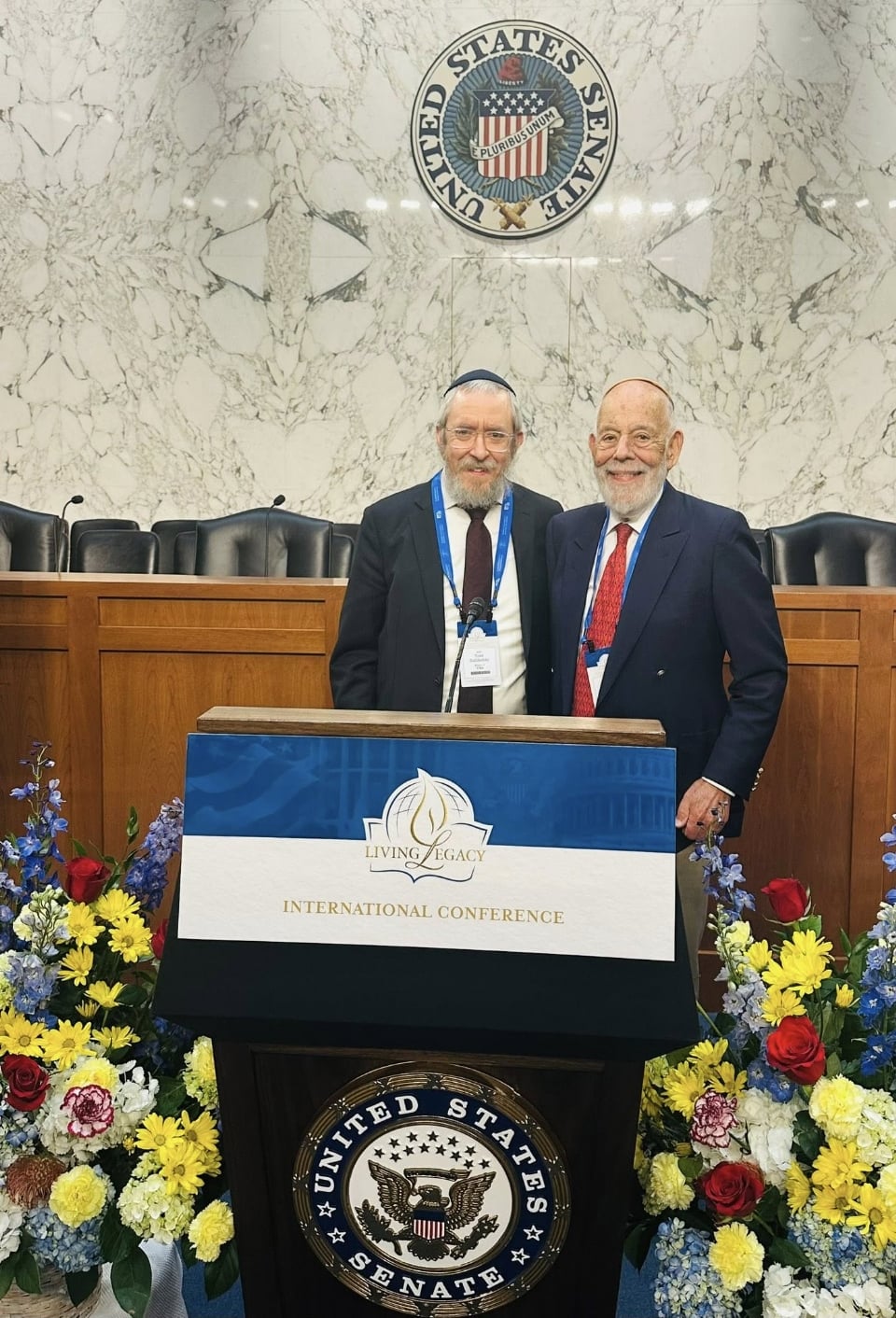
This week, I had the privilege of participating in the Living Legacy Conference in Washington, D.C., together with Dr. Larry Friedman ( some photos). The conference, held in advance of the Rebbe's 32nd Yahrtzeit, brought together rabbis and community leaders from across the world for several days of learning, inspiration and meaningful dialogue. Lawmakers, ambassadors, policy experts, and Jewish communal leaders shared valuable perspectives on the challenges and opportunities facing the Jewish people and Israel. 

During a luncheon at the State Department, Israel's Ambassador to the USA, Yechiel Leiter, referenced an idea attributed to Viktor Frankl. In addition to the Statue of Liberty, he suggested, America should erect a Statue of Responsibility. Liberty is only half the story. Freedom achieves its purpose only when accompanied by responsibility.

The ambassador then said: The Rebbe did more than advocate for a statue of responsibility. He inspired generations of ordinary people to take personal responsibility for Jewish life. Responsibility for their own Judaism. Responsibility for their families, their communities, indeed every person within their circle of influence. Rather than building a statue, he built living, breathing people who feel responsible for one another and for the future of the Jewish people.

We actually study this very idea this week. When the Jewish people asked to send spies into the Land of Israel, G-d told Moses, "Send for yourself men." Many commentators ask: G-d always explicitly commanded Moses what to do. Why, with the spies, did He suddenly leave the decision in Moses' hands?

Perhaps the answer is that at a certain stage, a leader must do more than simply follow instructions. A leader must learn to think, to judge, to take ownership, and to assume responsibility. G-d was teaching Moses that leadership means more than carrying out orders. It means embracing the mission so completely that it becomes your own.

Thirty-two years after the Rebbe's passing, that remains one of his most enduring legacies. He challenged people not merely to follow, but to lead. Not merely to observe problems, but to take initiative. To invest their minds, hearts, and souls in strengthening Judaism and uplifting those around them through acts of kindness, inspiration, and Jewish engagement.

The question is not whether we are capable of changing the entire world. The question is whether we are willing to take responsibility for the small corner of the world that has been entrusted to us. If each of us lifts up our own corner, then together we can help bring the entire world closer to its perfection the Rebbe so longed to see.

How Many Days a Week Do You Exercise?


We recently piloted a program for teenagers called Level Up Shabbat. Participants could choose one or more ways to enhance their Shabbat experience. Some committed to lighting Shabbat candles, reading the Torah portion, or being present at Shabbat dinner. Others chose to put away their phones for part of Shabbat, etc.

It raised an interesting question: Is there value in embracing one component of Judaism even while other aspects are not yet within your reach?

Judaism's answer is a resounding yes.

Too often, people view Judaism through an all-or-nothing lens. If I am not prepared to keep every aspect of Shabbat, then why should I keep any of it? If I do not put on Tefillin every day, then why do it once a week?

But that is not how growth works.

Nobody says, "If I cannot exercise every day, then there is no point taking a walk today." Or, "If I am not ready to eat healthy all week, then I may as well make unhealthy choices today." We instinctively understand that every positive choice has value, even if it is only one step in a much larger journey.

The same is true spiritually.

One should light Shabbat candles this week even if they are unsure about next week. One should put on Tefillin today even if they are not yet ready to do so every day. One should choose a Kosher restaurant today even if they do not know if they will tomorrow. Every Mitzvah has value on its own.

We see this idea in the Torah itself. A person who was unable to bring the Passover offering because they were ritually impure or ‘too far’ from Jerusalem could not participate in what may have been the centerpiece of the holiday, yet they still ate Matzah and refrained from Chametz. Missing one component did not make the others meaningless.

The same is true throughout Jewish life. We should never allow perfect to become the enemy of good. If we have an opportunity to embrace one Mitzvah or one Jewish experience, we should take it, even if we are not yet ready for everything else.

In fact, that is often how lasting growth happens. One small step leads to another. One Mitzvah inspires the next. And before long, what once seemed out of reach begins to feel completely natural.

Reflections on Our 20th


I’ve been reflecting on what makes for a good and enduring relationship. Over the years, I’ve asked couples celebrating a 40th or 50th anniversary what their secret is, and some of the answers have been surprisingly simple: “Marriage is a choice. I choose my spouse every single day.”

Those words carry more depth than we may realize.

When two people first meet, they may be drawn to certain qualities in one another. Kindness. Beauty. Personality. Shared interests. But the reality is that over the course of life, all of those things can evolve and change. Circumstances change. Stages of life change. And if a relationship is built only on specific qualities or conveniences, what happens when those things shift?

A lasting marriage means that the relationship runs deeper than any single characteristic. It is not merely love for certain qualities. It is a soulful bond that transcends the qualities themselves. Marriage means: “I choose you,” because our connection itself has become essential and unconditional.

Interestingly, we just celebrated Shavuot, the holiday that commemorates the marriage between G-d and the Jewish people. And unlike other major Jewish holidays, Shavuot has almost no defining physical features.

On Passover we eat matzah and sit at a Seder. On Sukkot we sit in the Sukkah and wave the Four Species. But Shavuot has no central physical symbol at all. Why?

Because Shavuot represents something deeper than symbolism. It represents commitment itself. At Sinai, G-d chose the Jewish people, and the Jewish people chose G-d. A marriage. An unconditional bond. Any external feature would almost distract from the essence of the day.

And perhaps this idea affects Judaism in our own lives as well. If we do things only because of the benefits they provide us, then the moment those benefits weaken or disappear, our commitment may disappear with them. For example, if the only reason a person values Shabbat is because it creates beautiful family time, what happens later in life when the children grow older and leave the house, or when life becomes busier and more complicated? But when something is rooted in identity, purpose, and an unconditional bond, it endures through changing circumstances and is far more likely to be passed on to our children and grandchildren as well.

Is there such a thing as “enough” charity?


American Jews are among the most charitable groups in the country, giving far beyond our small 2% of the population. It is one of the beautiful qualities of our community. And while Judaism certainly teaches concern for humanity as a whole, it also teaches that it comes only after our own community’s needs are taken care of.

This leads to a broader question: what actually motivates a person to give?

At the first and most basic level, a person gives because they are feeling generous today and want to do something good. There is certainly value in that. But naturally, the giving usually lasts only until one’s own emotional need is satisfied. Once the person feels they have “done something nice,” the motivation fades.

At a deeper level, a person gives because they are responding to a specific need. Someone is struggling. A school needs support. A family needs help. A community has to reach a goal. In this case, people often give far more than they originally planned, because they genuinely want to see the need addressed.

But then there is a higher level still. Those rare individuals in the community with an insatiable appetite for giving, not only because it feels good, and not only because there is a need, but because generosity becomes part of who they are. They stop viewing charity as a transaction and begin viewing it as a relationship with G d.

Often, we approach giving with endless calculations. We first need to determine exactly what amount feels fully comfortable, or we need to get permission from our financial advisor. Of course responsibility matters, and Judaism does not ask us to be reckless. But at the same time, a life of meaning can never be built only around comfort and calculation. Sometimes you need to go beyond and give it all you have got.

When it comes to our physical health, or the wellbeing of someone we love, we never say that we have spent enough. We go far beyond what feels convenient. Judaism asks us to see goodness the same way. To keep growing. To keep giving. To keep stretching ourselves beyond the comfort zone.

And, I have yet to meet someone who truly regretted the charity they gave.

Is your last holiday over yet?


Yesterday, a British friend told me he was going on holiday. Of course, he meant vacation. It struck me how differently that word is used. In America, a holiday usually means a special day on the calendar. In much of the world, a holiday means time away, time to recharge, time to reset.

But in truth, our Jewish holidays are both. They are sacred days to celebrate, but they are also meant to refresh us, educate us, and carry us forward long after the day itself has passed.

Just think about Passover. Nobody experiences Passover only on the night of the Seder. Weeks beforehand, homes are cleaned, food is prepared, plans are made, excitement builds. And afterward, its message is meant to remain with us: freedom from our limitations, and faith in G-d. Similarly, Shavuot, just a few weeks away, teaches us our mission and purpose in life. Rosh Hashanah calls us to reflection and renewal. Yom Kippur teaches us to return to our truest identity. Sukkot reminds us of joy in life, and trust in G-d.

Which brings us to today, the “Second Passover.” In Temple times, it gave a second chance to those who were unable to bring the Passover offering at the proper time a month earlier. But its message is timeless: it is never too late. We may miss an opportunity the first time, but it is never necessarily lost. There is always the ability to return, to repair, and to make it right.

The goal of a Jewish holiday is not just to celebrate it while it is here. It is to internalize its message so deeply that it influences the months before it, and the months after it as well, all year round.

A holiday is not meant to interrupt life. It is meant to elevate life. So perhaps the question is not only, “How will I observe the next holiday?” But also: “What part of it will still be with me when it is over?”

Looking for older posts? See the sidebar for the Archive.